Can You Sit A Level Science Exams Online?

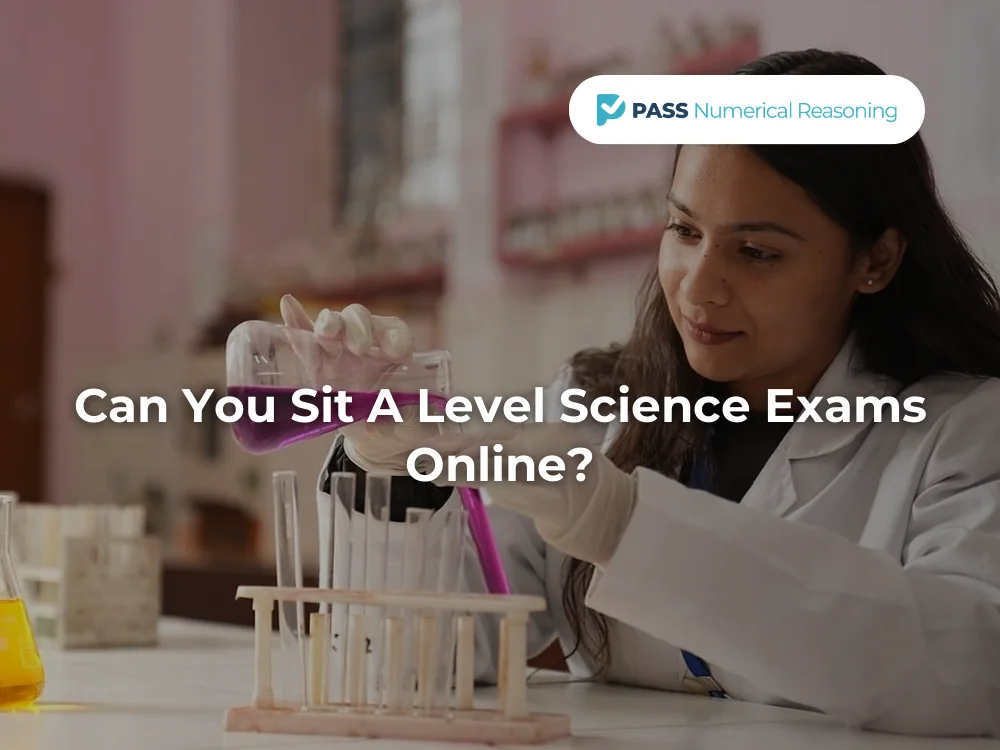
Yes, you can sit A Level science exams online. With a Pearson Edexcel International A Level, you sit each paper from home while a live Pearson invigilator supervises you remotely, so if you have been wondering whether you can take A Level physics online, the answer is a clear yes.
Pass Learn is one of the only providers in the world offering this, and its exams page explains how to sit A Level exams online in more detail. UK A Levels from boards such as AQA, OCR, Edexcel and WJEC, along with Cambridge International A Levels, are still sat at an exam centre, so the online route applies to the Pearson Edexcel International A Level only. For anyone who likes their facts in figures, this guide breaks the science papers down by the numbers, then clears up a few common myths.
The Science Papers by the Numbers
At Pass Numerical Reasoning, we know our readers like to see the data before making a decision, so here are the figures worth knowing. There are 12 Pearson Edexcel International A Levels that can be sat online through Pass Learn, and Physics, Biology and Chemistry are three of them. Each of these three sciences follows the same pattern:
- Six papers, booked together as a whole subject
- Two papers of 1 hour 30 minutes, each worth 80 marks and 20% of the qualification
- Two papers of 1 hour 45 minutes, each worth 90 marks and 20%
- Two practical skills papers of 1 hour 20 minutes, each worth 50 marks and 10%
- Start times of 07:00 or 10:00 UK time
Add those up and each science comes to 440 marks across six papers, with 80% of the qualification coming from the four theory units and 20% from the two practical skills units. All three sciences are paper-based. You print a PDF answer booklet at home, write your answers by hand, then scan and upload every page straight after the exam. Some booklets run to 40 pages, so check you have plenty of ink and paper well before exam day.
Physics: Where the Calculations Live
Physics is the science most people picture when numbers come up. Unit 1 covers Mechanics and Materials and Unit 2 covers Waves and Electricity, before Unit 4 moves on to Further Mechanics, Fields and Particles and Unit 5 to Thermodynamics, Radiation, Oscillations and Cosmology. Unit 3, Practical Skills in Physics I, uses short-open, open-response and calculation questions, with no multiple choice.
If you want to sit your physics exam online, Pass Learn books it for the Summer (May/June) and October series. There are no lab practicals to set up at home, because practical skills are assessed in the written papers for Units 3 and 6.
Chemistry: From Multiple Choice to Organic Chemistry
Chemistry opens with Unit 1, Structure, Bonding and Introduction to Organic Chemistry, which starts with multiple choice questions and then moves on to short-open and calculation questions. Unit 2 covers Energetics, Group Chemistry, Halogenoalkanes and Alcohols, Unit 4 looks at Rates, Equilibria and Further Organic Chemistry, and Unit 5 deals with Transition Metals and Organic Nitrogen Chemistry.
Units 3 and 6 test practical skills on paper, and International A Level Chemistry has no practical endorsement, so there is nothing extra to arrange. When you book the online A Level chemistry exam, you choose the Summer or October series and all six papers are included.
Biology: Reading Science as Well as Writing It
Biology suits people who like to interpret information as well as recall it. Units 1 and 2 cover Molecules, Diet, Transport and Health, then Cells, Development, Biodiversity and Conservation. Unit 4, Energy, Environment, Microbiology and Immunity, includes synoptic questions, while Unit 5, Respiration, Internal Environment, Coordination and Gene Technology, includes questions on a pre-released scientific article.
As with Chemistry, International A Level Biology has no practical endorsement for you to arrange, and Units 3 and 6 assess practical skills in writing. Booking the online A Level biology exam gives you entry to every paper, your Pearson results and your Pearson certificate.
Online Science Exams: Myths Versus Facts
A handful of misunderstandings come up again and again. Here is how they compare with the facts:
- Myth: you need a lab at home. Fact: practical skills are tested in written papers, so there is nothing to set up.
- Myth: only school pupils can sit them. Fact: the route is open to anyone, including 16-year-olds, adults and resitters, and you need no evidence or reason to sit at home.
- Myth: any A Level can be sat online. Fact: only the Pearson Edexcel International A Level is sat this way, while UK A Levels and Cambridge International A Levels are sat at a centre.
- Myth: you can sit whenever you like. Fact: the sciences are booked for the Summer (May/June) and October series.
- Myth: nobody is really watching. Fact: a live Pearson invigilator can see and hear you during set-up, the exam and submission.
- Myth: an online exam counts for less. Fact: you receive the same Pearson results and certificate, and UK universities accept International A Levels grade for grade.
For more on how the supervision works, Pearson’s remote invigilation service explains that you cannot see or hear the invigilator, who communicates by typing in a chat box.
What You Need at Home
The checklist is short but strict. You need valid, in-date photo ID (a passport, national identity card, driving licence or UK citizenship card), a quiet and private room rather than a shared space, and a printer and scanner with enough ink and paper. You also need four devices: a laptop with a webcam that stays plugged in, a phone with Pearson’s app, a backup recorder and a separate phone so your responsible adult can call Pearson’s helpline.
That responsible adult can be a parent, guardian or other adult, but not your tutor or teacher. They are there when you log in, stay available outside the room for the whole exam, supervise any toilet break (the exam clock keeps running) and call Pearson’s helpline if the connection drops.
Your ID is checked twice. After you book, the exams team asks for a photo of it with the details Pearson needs and sends them with your entry. Then, at the start of each familiarisation session and each exam, you hold it up to the camera for Pearson’s invigilator. Pearson’s familiarisation, which includes a check of your equipment, is compulsory, and you complete it at home in your own time. Pass Learn sends you everything you need for it and for the ID check, but if you skip it, Pearson removes your entry with no refund. You can also sit from abroad where Pearson offers remote invigilation in your country, but exam times are UK time, so check the time zone.
Recognition and Optional Study
Pearson Edexcel International A Levels are internationally recognised, and UK universities accept them grade for grade. Pearson describes them as comparable to GCE AS and A levels, as confirmed by NARIC, and you can browse the International A Level specifications on its website. Each course sets its own entry requirements, so check yours before you book.
Studying is a separate, optional decision. For structured preparation, Pass Learn has self-paced A Level courses you can take from home, which you can start before or alongside your exam booking.
Pass A Level also covers studying A Levels at home, with fully online learning designed for independent study that only needs a smart device, an internet connection and your time.
Conclusion
For a numbers-minded learner, the online science route is easy to measure: six papers per subject, 440 marks, a Summer and an October series to choose from and a live Pearson invigilator at every sitting. Physics, Biology and Chemistry are just three of the 12 subjects on offer. Pass Learn enters you with Pearson as a remote invigilation candidate, and you can sit A Level exams online once your booking is confirmed. The team replies within one working day and confirms the deadline for each series, so it pays to book early.
Frequently Asked Questions
Can I really take A Level Physics online from home?
Yes, as a Pearson Edexcel International A Level. You sit all six papers at home with a live Pearson invigilator, in the Summer or October series.
Are the science exams answered onscreen or on paper?
All three sciences are paper-based. You print the PDF answer booklet, write your answers by hand, then scan and upload every page straight after the exam.
Do I have to carry out practical experiments?
No. Practical skills are assessed in written papers (Units 3 and 6), and there is no practical endorsement to arrange for Biology or Chemistry.
Can I resit only some of the units?
Each science is booked as a whole subject with all six papers. If you only want to resit some units, speak to an adviser before you book.

Pass Numerical Reasoning Team
We help thousands of students each year with revision, courses and online exams.